Home

Showing posts with label writer's life. Show all posts

Saturday, August 8, 2026

Changing with the Seasons of Life

I’m a night owl through and through (so is my son, which is its own blessing and curse). I can’t remember a time I didn’t feel more productive in the evening. I’ve always felt more comfortable in the dark and cozy time in the night, when everything is quiet, everything is done, and I can finally let my mind play.

That is, until I had my son.

Turns out, as a mom, there is never a time when everything is done. The evening has transitioned for me from a time when I could finally relax and let my imagination run wild, to a time when I have to try and fit in the million things I wasn’t able to get done during the day. To the time when I still have my ear half listening for cries and whimpers, even though my son has been sleeping through the night for almost two years. To a time when I’m so depleted and exhausted, I have nothing left to give to anyone. Not even my story.

At first I thought I needed better systems. Ways to get more done, so there was less remaining to be done at the end of the day. And that has helped. I do feel like I have more mental bandwidth now that I have improved my system. But still, at the end of the day, I felt too tired to do anything. My body and brain were exhausted. Far too tired for the exciting—but also demanding—work of creating. While I love writing, it takes a lot of energy, and focus. And I just didn’t have that at night anymore.

I evaluated all the productivity advice I’ve heard over the years, and tried to think of another solution, but the only one I could come up with was to start my day writing. Its advice many have given before. Focus the beginning of your day on what matters most, when you have the most energy to give. Before, I’d never thought this advice would work for me. Because I’ve always been a night owl writer.

But desperation is the mother of invention, so I decided to give it a try. I set my alarm for six am, went to bed early and prayed for a good result. I even set up a reward system, to incentivize myself for getting up early, fully prepared that it would be like pulling teeth to get myself out of bed before the crack of dawn. And for the first week, I employed that system. But early on, I discovered something I never could have guessed.

I liked getting up early.

It didn’t take long before I began adapted my whole life around waking up early. I was naturally going to bed earlier, so I could get up earlier. I was even waking up before my alarm went off some mornings. I was getting mad when I couldn’t get up early. Because I found that I enjoyed that quiet time in the morning more than the quiet time at night. Because I wasn’t exhausted. I wasn’t already tapped out and only capable of doomscrolling on Instagram. I was able to be me. The person I was before all the mental labor of being a mom.

I started getting more writing done. I am now almost halfway finished with a revision/rewrite project I’ve been wanting to do for years. I’ve been consistently making progress, which I haven’t been able to do for over a year, and I couldn’t be happier.

When I first started this new schedule, I feared it would make the end of the day worse. That I would be run even more ragged than before, since I started the day earlier, but I haven’t found that to be the case. Sure I’m tired at the end of the day, and more inclined to go right to bed after my son falls asleep, but no more so than before. As I’ve made this change, I’ve noticed that getting up early gives me more energy. Taking time for myself in the morning, to focus on me before everyone else, has filled my cup in a way I’d been missing.

I wasn’t just able to do my writing, but to be a better mom too. I was also able to be more patient with my son, because I wasn’t waking up and instantly being thrown into mom mode. I was able to play with him in the morning, because I was already awake and enjoying my day. I found I was writing more. Not just in the morning, but any time I could find. I’m now more inclined to pick up my writing than I was before, because I’m already connected to my story from my morning writing session. 

The toddler stage is just a season, and I’m sure that once my son is through this season I’ll need to reevaluate my writing time again. Maybe in the future, writing at night will make more sense. Maybe in the future getting up early won’t be possible (I’m already dreading having to get him up another hour earlier for kindergarten in a few years), but for now I’m changing with the season of life I am in. And I’m grateful I’ve have found a way to be the mom I want to be, while also finding a little time for myself and my own goals. Even if it’s at an ungodly early hour of day.

So if you’re struggling and finding at this moment you can’t fit in what you need, or your losing yourself to the stage of life you are in, take a moment to evaluated what you need. Try to figure out where you can find time for those things, even if its somewhere you might not expect. Play around, experiment, try something new and see if it works. It might not. But once you find what does, and you’re able to find a way to fit yourself into whatever this tough stage may be, you’ll be glad you did.

Wednesday, July 8, 2026

New Systems, New Momentum

I've noticed over the past few months I've been struggling to get anything done. As a toddler mom, I probably never have enough time or energy for everything I want to do, but with a few prolonged bouts of illness this summer, I’ve been struggling more than usual. As someone who is used to being productive and going after my goals, it’s been difficult to deal with this season where I have nothing left to give. Physically or mentally.

One of the difficulties of having a young child is that you often have so many balls in the air at once, and you are so focused on keeping them going, you can’t think about anything else. I’ve got to keep my son alive, which includes bathing, feeding (even though he only likes three things), and forcing him to sleep the best I can. Maintain the house while he simultaneously tries to destroy it. Remember snacks for daycare and the swim stuff for lessons. And that doesn’t even touch on all the needs for my evil day job.  It can be overwhelming to keep all those plates spinning when you’re already on empty.  Trying to remember everything is a full-time job of its own.

So this month, I made a list of everything that need to get done on a daily, weekly, or monthly basis (a quarterly or yearly list might be necessary too, but I'm holding off on those until I've refined the system more). I assigned everything a day of the week and created a daily to do list of every day of the week with everything I need to do, down to putting the recycle in the bin each night. What days the laundry is done. What day I fill the coffee pods. What day I clean the fridge. Anything that needs to get done. Thereby allowing myself to release those thoughts from my mind. I don’t need to worry about when the flowers were last watered or groceries were ordered, because I have a day set aside for that and I know it will be done on that day, and it doesn’t need to be done sooner. If it did, it would be on my list sooner.

And as the month progressed, I’ve added more and more things to lists. More areas of stress or irritation that can be solved by being ahead of the game. I create list of items in the house that need to be constantly restocked, and designated a day to when I would determine if they needed to be purchased or not. No more getting home from the grocery store only to realize I’m out of soap and I need to go back. I’ve moved some activities from the morning to the evening, such as refilling the coffee pot with water (because nothing is more upsetting to my morning than having to delay getting coffee because there is no water in the pot), focusing my nights to set up the best morning, and day, I can.

I've even started adding meal planning to my daily list. Giving each day’s dinner a theme, such as Mexican on Tuesdays and Pizza on Friday. It might not be an exact meal, but even just having a theme limits my options, and allows me to decide what to make for dinner faster.

And so far, it’s been working well. It’s amazing the freedom taking these many little decisions throughout the day off my plate has created. I don't have to wonder if I should do the laundry, or if it’s been too long since I’ve scooped the cat’s litter, or if we are almost out of laundry pods. I have a day for that, a system for that, and until it shows up on my list, I don’t need to worry about it.

And limiting how many decisions I have to make throughout the day has freed up my mind for other things. Most importantly for creativity and writing. I didn’t realize how much all those little decisions were draining my energy. How much trying to keep everything in my head was stealing my creativity. Until it was gone. I just knew I was always too tired, too overstimulated to focus on writing. I never looked deeper.

But now that I’ve freed up some of this mental headspace, I’m able to think about my characters. To ponder what they are doing, how they arrived in their current circumstances, and how to get them out of it (and probably their clothes). I’m able to hear the words again, and get random ideas while walking or doing dishes like I used to.

I’m still working through the kinks of this new system, and finding new areas I can embrace to eliminate even more decisions from my daily routine. And once I have it perfected, I’m sure life will change. My son and his needs will no doubt change over time. As will mine. But finding these areas of relief, even if it’s just for this moment in time, has been so vital to my mental health.

So I encourage you, if you’ve been feeling overwhelmed in this season of your life for any reason, or even if you’re not feeling overwhelmed but just feel your life could improve with more organization and focus, take a moment to write down everything that is bogging you down. Everything that splits your focus, or raises your stress, and trying to create a system to eliminate or minimize it. Find ways you can take duties off your mind and put them on paper, and free your mental space up for more. No matter how difficult it might sound to start, it will be well worth it in the end.

Monday, June 8, 2026

Question the Revision Premise

Becca Symes has a great podcast where she discusses assumptions authors make about the process and if they are valid. Every month she debates a new notion, or premise, that many authors act as if it is fact without even considering why or if it was right, such as books can’t market without being on social media or writers have to write every day. She asks why this belief exists, if it’s true, can it be changed, and if this premise is serving writers.

I’ve listened to Becca Symes question these premises for years, and I’ve learned a lot. As someone who has a less traditional writing style, I’ve always thought I was good at questioning the ideas that I have. The notions that have been unintentionally spread by the masses. But this month, I realized I had a huge belief of my own that I’ve never questioned, and that definitely wasn’t serving me.

Revising has always been my least favorite part of the process. I love writing. The exploration, the fun, the lack of limitations in the first draft. But having to turn all that enjoyment and free creation into something that makes sense to everyone else has always been a struggle for me. While writing flows out of me fast and exciting, revisions take forever and can be painful. Especially that first revision.

One of the reasons I think writing goes more smoothly for me is because I allow myself to work on whatever part of the story I want to work at that time. I usually start in the middle, with a sexy scene, and work my way out (though not in any kind of organized manner). I allow myself to explore whatever scene I want to write that day. But when it comes to revising I’ve always thought I had to start on page one and work my way forward. It makes sense. Or does it?

As I’m staring down the barrel of a lot of revisions (not just the books I’ve written over the last few years, but also all of my older works that I am trying to republish), I’m desperate for a way to not only speed up the revising process, but to make it less painful as well.

That’s when I thought back to Becca Symes, and her QTP podcast,  and wondered do I have to revise this way? Do I have to revise starting on page one, or can I move around, working on whatever scene I’m inspired by?

It’s an interesting idea. I’m not sure yet if it will work. I certainly think that I’ll have to do a round of revisions the whole way through at least once. But maybe starting out with revising certain scenes, especially the fun ones in the middle, might help speed up the process, or at least make it more enjoyable.

As I get started on revising these next few books, I’m going to give this a try, and revise in the order my brain and heart want to go and see how it goes. It might blow up in my face, or just simply not make enough sense to keep going, but it’s worth a try. And even if it doesn’t work, at least I’ll know I questioned the premise and the premise is correct. At least for me.

What beliefs do you have in your head that you’ve always assumed have to be true? What can you question about your processes that might open up a whole new world?

Saturday, December 13, 2025

Christmas—not always a joyful time of year

Christmas is about colored lights, decorated trees, and gift giving, but it’s also a time for deep reflection and sadness, for some.

While most people are celebrating Christmas with their families, others might be alone and feeling miserable. It’s especially hard if you just lost a loved one to be reminded of that loss.

I’m fortunate to still have my family, but our holiday get-togethers now have changed. We used to have huge Christmas Eve gatherings and exchange tons of presents. It was exciting and a little overwhelming. Now, we have quieter get-togethers with less presents. We’re all older now and pretty much have everything we need anyway, and it gets harder to decide what to buy people, even ones you know well. That was a stressor for me every year at Christmas.

The unfortunate part of our Christmas gatherings in recent years is that they aren’t always happy occasions. Yelling at each other is a new addition. Those sweet, innocent times are long gone now with the rise of lies and fake posts spreading on social media and cable news, the latter of which really isn’t news. Those so-called news channels are meant to anger people. And the trolls on social media are intentionally trying to cause rage. It’s sad, but a part of our lives now.

The good news is my husband and I have our own intimate Christmas celebration and traditions that help me through this time of the year. I think, no matter what, you need to find your happy place.


Hopefully, we as a nation can get past all of this anger, and I hope my family can too.

Merry Christmas, Happy Yule, and Happy Winter Solstice to everyone.


Enter a world of enchantment and passion.


Tuesday, April 8, 2025

Untraditional Productivity Hacks

For years I’ve been scanning the internet for different ways to increase my productivity. As an author, there is never enough time to do everything you want. When I became a mom, I was even more desperate to get not just more done, but anything done. I became desperate to any new nugget I could find to improve my productivity. But a lot of what I heard was the same advice over and over. The same recycled ideas. So I decided to start trying some untraditional things, just to see if they worked. And a few did.

Here is a list of some of the habits I’ve been using to make myself more productive, that are either unconventional, or are in direct opposition to most traditional productivity advice, but worked for me. Maybe they will work for you too. 

Do what you want. Sounds good right. But I have some reasoning behind this, I promise. 

All of us constantly have a running to do list in our minds. Some things that need to be dealt with immediately, like make dinner, and bigger tasks like reorganizing the kitchen, or writing a novel. Each one of those little activities nipping at us like a dog, demanding attention, stealing our focus.

When I have one of those particular to dos talking to me more than any others, that’s the one I do. Even if its not my number one priority. Even if it doesn’t need to be completed for months. If it is being too loud, I know it will be easier just to do it now, and silence that voice rather than spend the next hours, days, or even weeks wasting precious energy and focus to ignore it.

I also think this leads to the best result as well. Sure, maybe I don’t need to write my May newsletter right now, but if I have something I really want to talk about, I think it will be a better newsletter in the end if I write it now, when I’m passionate about the topic. Rather than trying to strain my mind to come up with something the day before it has to go out.

Is it possible I would be further ahead in my revising right now, if I stuck to just want needed to immediately be done, instead of getting next month’s newsletter done ahead of time. Maybe. But I don’t think I’ll be unhappy when I don’t have to worry about my newsletter in May, and can instead spend that time revising. It's even possible I am further along in my writing because I do these activities ahead of time, since I’m not using an excess energy trying to ignore any of these to dos in favor of revising.

This definitely isn’t something you can apply across the board. Sometimes you have to do what’s right in front of you, regardless of your passion for it. Your kids can’t wait until tomorrow to eat dinner because you got the idea for a blog today. But you’d be surprised how just even jotting down notes about an idea that is pestering you can free up your energy and make you more productive than before.

Tackle the small things first. I’ve heard many productivity experts encourage people to do the hardest job on their list first. After that, everything else will seem easy. But that assumes that you have time to tackle anything else. Sometimes you just don’t. Instead I try to tackle the small things first. If there is something on my to do list that can be accomplished in fifteen minutes or less, I do it now. Period.

This helps me in two ways. One, I get more done. Sure, it's more of the little stuff. But it's still two things (or possibly more) coming off my list in that time instead of one. Especially since sometimes I just don’t know how much time I have. When your schedule is dictated by a toddler, you have to be prepared to finish what you are doing quickly.

But this also helps me focus my energies. I know I’m not decluttering my closet this weekend. I know I’m not painting the garage. So even if my subconscious nags me to do it, I can ignore it. This limits how much I’m trying to hold in my brain, searching for my attention, thereby freeing up more brain power for me to focus on other things.

And it also helps to keep you motivated. Nothing gets me more excited to move on to the next task as crossing off the previous activity. If you can knock five or six tasks off your list, you feel unstoppable.

Scroll on your phone first thing in the morning. This is one that every productivity and self-help guru tells you not to do. But first thing in the morning, is exactly when I allow myself to scroll on my phone, because I don’t have long to do it. There is a hard stop for when I have to get off my phone. Once my son is up, unless I want to share my phone with him, it has to go away.

When I pick up my phone other times of day, like at lunch or at night, with no hard stop, I can find myself scrolling for way too long. At night, I can spend hours just watching reels of bookish memes and parenting advice. Hours I could be spending doing something else. With only a few minutes to play in the morning, I get on social media, see what what’s going on, and then I have to get off.

If looking at social media first thing in the morning bothered me, I’d stop immediately. If it caused my day to start off poorly, or put me in a funk, I would change tactics. But luckily, it doesn’t bother me too much. But the point is to find a time in the day when, due to circumstance and not an attempt at willpower, you can only be on the phone for a set period of time.


Stick it in the closet. A few years ago I stumbled upon a YouTube video that talked about the clutter in your house having a voice. Which sounded a little crazy (cue Ariana Grande Saturday Night Live sketch where she’s singing with the couch) but what the youtuber meant is that the clutter creates a voice in your head. Every time you walked past that cluttered counter, or the pile of unfolded laundry in the corner, a little voice would go off in your head saying you need to do this. Stealing a little of your energy and your focus. If you walk by in multiple times a day, that little voice could be notifying you dozens of times.

For anything that caused this reaction in me, I either solve it immediately or shove it in the closet. To keep those voices as quiet as possible. That bag of clothes to be donated but I haven’t been able to find the time to do it, stick it in the closet (car might be better, or garage, getting it one step closer to going out). That pile of unwashed or unfolded clothes, keep them in the laundry room until you’re ready to deal with them.

This may seem like an avoidance tactic, and it is. But being constantly reminded of what you aren’t doing, doesn’t help you get anything done. So for the time being, if you can’t do something, just stick it in the closet, and free yourself to do other things now, and thereby giving yourself time later to handle what you’ve tucked away.

As a side bonus, if you stick a bunch of stuff it in the closet, and find you don’t need it for months, or even years, that might be decluttering all on its own. Now you know you don’t need it, and you can just throw it away. No sorting necessary.

Keep changing the system. A lot of productivity gurus make it sound like if you start their system, all your productivity problems will be solved. You’ll get everything done on your to do list and have time to spare. And maybe that does work for them. And many others. But I have never found a productivity system that solved all my problems. 

Instead, what I have found is most successful is to keep changing the system. Some months I’m making to do lists in journals, next few months I might be using a paper planner, the month after that I’m making excel spreadsheets full of plans. 

No matter how good the system is, after a while I always grow bored with it. I’ll find issues with it accommodating my lifestyle. Or I become overtaxed by it. And when that happens, I change it.

Switching up my system not only reinvigorates my interest in my goals, but it also brings them back to front of mind. Whenever I change systems, I usually have to spend a few hours resetting everything. Refill out trackers, and replan weeks. That gives me time to think about what I want. About what I need. And why these goals matter to me. Which only makes me want to achieve them more.

By no means am I saying throw out a system that works for you. If seeing your goals splayed out before you in your office keeps them top of mind, then continue to do that. But maybe you can change up how you display them, what you display. Maybe you show the end results of reaching your goals, like a big new house, instead of a written out list. Keep switching up what you do, until you find something that works for you, and when it stops working, don’t be afraid to change it again.

These are just a few of my productivity hacks that are rather untraditional compared to traditional advice, but have worked for me. Do you have any productivity hacks that you love and want to share? Anything you do that seems a little unusual or unconventional but works? Leave it the comments below. I’d love to find some great new ideas to try.

Wednesday, January 8, 2025

New Year, Same Determination

A long, long time ago, when I first discovered by love for romance novels and was struck with the desire to write my own, I went to Walden Books (yes, that's long ago it was) and picked up Writing Romance for Idiots. A close cousin of the popular dummies' books. This was before yahoo groups and social media. It wasn't before the internet, but definitely predated using the internet for absolutely everything, like we do now. Back then I wanted to write traditional historical romance novels, like the ones I read and loved. Which I still dream of writing, with a saucier twist than the ones I wrote back then. 

How to write romance for idiots gave lots of great advice. I haven't read the book in ages, but I'm sure much of it doesn't apply any longer. The industry has changed so much since then. But one of the tips I always remember was to go to a bookstore and see where you're books would fit on the shelves. The idea was to pick a pen name that would situate you near authors of similar genre, so you might attract a reader to pick up your book along with your fellow author's.

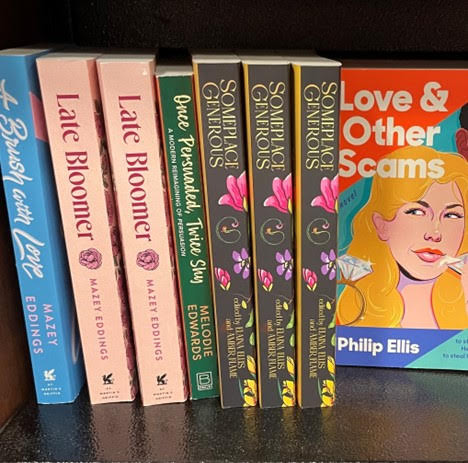
This is where my books would reside in my local Barnes and Noble

This advice isn't relevant to how readers discover books anymore, but it's still a habit to check out my sister authors every time I enter a bookstore. I love to see what other authors I would be surrounded by if I did get my book into their bookstores. Or what covers might border my books.

For the last few years, my life has been crazy. So much has been changing. My family, my location, my priorities. It would have been easy give up on my writing amidst all this upheaval. I'm almost ashamed to admit, I did consider it. Especially after being so long without finishing a book, and knowing how much work it will be to get back to where I was before. I had to really take stock if I still wanted this writing career anymore. Maybe I'd done what I wanted to do. I'd been published. I made a little money. I made some great friends. Maybe I should walk away with my good memories and be done.

But the more I thought about giving up, the more it became clear I couldn't do it. Not just because I still have so many characters and stories running around in my head (though that is true). But because there are so many goals I still want to accomplish. So many things I wanted to do and see and experience with my writing. I wanted to see my book on those shelves, sandwiched between such prized authors. I wanted to get the chance to write the historicals that drew me to romance in the first place. And paranormals. And dark romance. And maybe dystopian or fantasy. I wanted to see readers devouring the books I write. To know, even for a little while, I gave someone else happiness and joy with my words.

I couldn't walk away. I couldn't give up on myself and my dreams like that. My only option was to keep going, to keep pushing, no matter how hard. Even though I won't be able to devote the same time and energy that I used to. I'm still going to work towards these big goals. Because some dreams are worth fighting for. And this year I am determined to make them happen.

And I hope you do the same for yourself. Never give up. Never stop trying. If it's something you really want, keep fighting. Because I have no doubt if I keep pushing, keep working and keep dreaming, one day I will accomplish these big goals and make my dreams come true. And I'm sure you will too.

Friday, November 8, 2024

A Thank You to All the Authors Who Helped Make Me

Since it’s almost thanksgiving, I thought I would take this moment to thank some of the authors that have made me the writer I am today (if I tried to thank them all, we would be here until next thanksgiving). These authors I have learned from, I have been encouraged by, and they have offered me the opportunity to grow into the author I am today.

Margo Maguire has probably had the biggest impact on me as a writer. She was the first romance author I ever read. I found her book by accident, on the end cap of a walden books (yes, I am that old). A historical romance about the illegitimate child of the king road tripping to court and finding love with the man escorting her. Instantly I was hooked. This started not only my love affair with romance novels, and specifically the historical romances novels, but after reading her book I realized not only that I wanted to be a romance writer, but I already was one. 

All of my stories up to that point had strong romance elements, but before reading her book I didn’t see that connection. I just thought I was writing books, trying to figure out my genre, and they just all happened to have romance. After reading her book I couldn’t deny the truth. Instead I embraced it. I started to create the stories I had wanted to tell all along, even if I didn’t know it back then. And its something I have continued to do, with all twenty seven of my published books (and many many yet to be published books).

Thank you Margo Maguire, for showing me not only a whole new way of writing, but the types of stories that I would be passionate to write for the rest of my life. Without you my characters wouldn’t get the happy endings they deserve, and I would still probably be searching for the genre I wanted to write. Whether it be mystery, paranormal, historical, or something else entirely.

Just like Margo Maguire, Joely Sue Burkhart changed my writing direction by showing me a whole different kind of story. When I first started writing romance I wrote much cleaner tales. They might have been a little steamy, especially for the era, but would be downright clean by today's standards. That is until I stumbled upon Joely Sue Burkhart in a romance writers yahoo group. She was talking about writing a book that would eventually become Hurt Me So Good, the second book in her Connaghers series. She made the first book sound so appealing I had to check it out. I had no idea what I was getting myself into when I picked up Dear Sir, I’m Yours, but it's safe to say my life has never been the same since. Her book was the first BDSM book I ever read, and started me on a journey into the deep steam and smut I love today.

Thank you Joely Sue Burkhart for opening my eyes to the stories I love to tell. Without you, my heroes would use far less rope, and my heroines would end up with far fewer bruises, and they would all be lesser for it.

I met Lexi Blake, who at the time was writing as Sophie Oak, at a conference many years ago. She was the speaker of the luncheon I was attending and by coincidence she ended up seated at my table. I was just a baby author then, with three or four books to my name and still trying to figure everything out. But she took the time to talk to me, to give me some good advice on how to conquer the industry, and made me feel like a valued part of the community, even though I was just getting started. This is a lesson I have always tried to pass on, offering whatever help and support I can to other authors, and to pass on the care and respect she showed me.

Without her advice on how to create a series, I would be a very different author today. My Frostbite Fall Christmas Ball series (which will be discounted during part of the month of December) is inspired by her advice and her Bliss, CO series. I even set my series in Colorado as a nod to her great writing and amazing series.

Thank you Lexi Blake for being so kind to a new author and giving me the encouragement to continue to chase this crazy dream we all have to put words on the page. Without you, there might be far fewer books in the world with my name on them.

These are just some of the authors that have made me into the writer I am today. Author’s whose words and stories have changed my life drastically. And though I doubt they will ever truly know the impact on me, I wanted to offer my thanks this November. Whether writing damsels in distress, smutty BDSM masters or kooky towns full of menage romances, they have all changed the direction of my life for the better and I thank them for every romantic, smutty, uplifting word.

Tuesday, October 8, 2024

Finding That Writing Mojo Dojo

I have always felt like physical places have energy. Sometimes its inherent to the place itself, and sometimes it can be created by what happens there. When buying all my houses, the second I stepped into the building I could just feel it was the place for me. Realtors would tell you they created that feeling (and I don’t think that’s completely untrue) but I think that the buildings themselves have a certain energy that I picked up on. Energy that welcomed me and soothed me and made me feel like this place could be my home.

I’ve also always believed that places have writing energy as well. Not that I can’t write anywhere, if properly motivated. I’ve written in some weird places throughout the years (during hockey games, in closets, on the couch while my whole family watched avatar), but when I settled down to writing in a place with that good writing mojo it always feels like the words flows better. It’s easier for me to get in that right headspace. Like everything just clicks a little faster, a little easier, a little deeper.

As a result, I tend to frequent places with good writing energy far more often. Especially when getting into that writing headspace can be even harder, due to stress, or real-life complications, or a strict deadline.

Here are a few of the places I like to write. Either because they have inherent great writing energy or because I’ve created it, by writing in these places enough that I can pick back up on that mindset the second I walk in the door.

While it may sound boring, my desk is one of my favorite places to write. Not because there is anything special about my desk. In fact, it’s pretty bland. Every year I think about fixing it up, getting some new stuff to make it more exciting and conducive to writing, but I always put it off. Regardless of how blah my desk might be, it’s a great place to get work done. Without any windows, and far away from the rest of the house, there are limited distractions to disrupt my flow. On a day when I don’t have the time to go anywhere else, I’ll put on some sounds (I need sounds instead of music, because lyrics can distract me when I’m writing, especially if it’s a good song), and shut off the world. 

After my desk, the most common place for me to write is my couch. I’m not sure it’s the best. It probably horrible for my wrist or back, but it’s the most well used spot in my house for everything. For eating, for reading, for writing/working, probably even for sleeping (I’m a big napper, which most often happens on the couch). But while it might not be the best for my body to write, the positive energy on my couch has served me well. Not to mention, there is something really nice about how writing on the couch connects my writing to my everyday life. While it can be freeing to escape from reality into my writing, sometimes it’s also nice to see my writing world as not a separate entity, but as a part of my life. An extension of the real me.

Barnes and Noble is one of my favorite places to write outside the house. I think being surrounded by all those books is great motivation. I look at all the books around me, at all the people who love those books, and it fills me with motivation to bring my characters into the world to be loved by readers just like the ones around me. Not to mention the snacks and coffee really help lubricate the writing process.

After Barnes and Noble, Panera is my next favorite place to write. The food is great, and the atmosphere—at least at my Panera—is focused. Maybe it’s because I live close to a large college, but most days I write at Panera at least half the restaurant is filled with other people on their laptops, writing presentations, trading stocks, editing videos. It can be quite a communal feeling, to see so many other people working to their goals, just like I am. And they make a mean grill cheese. What could be better than that?

I’ve always found walking very helpful for my writing process. It gives me time to think, to let my mind wonder and the ideas to flow. If I am going through a period of increased productivity it is almost always a time when I am consistently walking. And when I walk it isn’t uncommon for me to find a nice grassy spot to sit down and write. There is a perfect spot I used to tuck away into near my evil day job, just beyond the building I can’t see my office, or any other part of the realities of home, and I can just escape into my writing, with nothing to distract me from the world and characters I’m creating. I wrote most of my Frostbite Falls series in that spot, and to this day it is one of my favorite places to write. The wind, the trees, the birds, the sunshine, all only add to my enjoyment and my writing mojo.

These are the places I like to write the most. That have offer me just that little extra energy to make my words come to life. Where do you like to get your work done? What places have the best energy to you? Or help you be even more productive? Leave them in the comments below. Maybe we have some of the same places in mind.

Sunday, September 8, 2024

10,000 Hours to Mastery

They say it takes 10,000 hours to be a master at anything. I’m not exactly sure where that number came from, I guess it’s just one of those things people say. And I understand the logic behind it. It does take a lot of work and a lot of determination to master any skill. More time than most people want to put in. 

That’s why masters of anything are so rare.

I am not about to call myself a master of anything (nor do think I have put 10,000 hours into anything) but it is certainly something I aspire to when it comes to my writing. Though I’m not sure if I believe anyone can truly be a master of writing, as a artform it is constantly evolving. What readers want, what they expect, even the words we use and the way we use them, is always changing. But that doesn’t stop me from trying. Even if I end up falling short, someone a little short of a master is still pretty damn good.

This is what I’m doing to try and work towards my 10,000 hours to master writing. Read. Both books of fiction and craft. I think reading fiction books, especially books in my genre is so vital to increasing my knowledge. Not just good books, but the bad ones too. There is so much that can be learned about the craft of writing from reading other books. What worked, what didn’t, what made you love a character, what made you hate them, how the authors style set them apart and why you loved or hated it. I’m often amazed by how much I pick up from reading without even realizing it. And as far as homework goes, it’s not to exactly a hardship to have to read a bunch of amazing books.

Reading craft books is also important (though I won’t lie, it’s not nearly as much fun). I try to read at least one craft book a year. Ones on writing, storytelling, plotting. My writing process is always evolving, and I love to get a different perspective and see how others are do what I love. All their tips might not be for me, but it’s impossible to tell when you might stumble upon that one idea that changes everything.

Take courses. Getting to mastery is about always learning. I love to take new classes, to learn a new tip or a new technique that can improve my writing. Even new knowledge that can expand and deepen my world. I don’t see myself ever writing a gory serial killer thriller, but you never know when I might write a character obsessed with murder podcasts, and all those police procedural workshops I attended will come in handy.

Listen to podcasts. I love to listen to podcasts by other authors. To hear what is working for them and what they are struggling with. Not only does it give me new ideas, I love the camaraderie that I get hearing about others in my profession. It’s comforting to know that others struggle with that exact thing that I have been struggling with. Or have a big success in a genre or project I’m considering pursuing. Some of my favorite podcasts are Six Figure Authors, Rage Against the Manuscript, and the Self-Publishing Show. Though I’m sure there are many more fantastic ones to discover.

Watch YouTube videos. Just like classes and podcasts there is a whole array of authors that create videos for YouTube. Content on what they are working on, what they are struggling with, how they are getting stuff done (these are my favorite, I’m a huge productivity nerd), even craft. There is a whole world to be discovered and explored on YouTube, and I love to do it.

Critiques. Getting critiques, or receiving a beta read, can be incredibly helpful. Getting a fresh new set of eyes on your work can help you see your writing more clearly than you could ever do on your own. Whether it’s a character trait, a writing crutch, or a confusing passage, getting feedback is vital to improve. Sometimes critiques might just find errors in this manuscript, but often they can bring to my attention bad habits and crutches I lean on far too often. Not just helping me improve this one work, but to improve my writing from this story going forward.

Just having a friend look over a few chapters or receiving a beta reader on the beginning of a book can be so eye opening. Though it can be tempting to skip this step, and plow through to the end (especially in this high-pressured publishing environment) I have learned from experience that nothing is more valuable to my work, and my mastery of this art, than feedback. No matter how hard it might be to hear sometimes.

Not only do I learn from receiving critiques and betas, but I learn from giving them as well. Seeing where someone else is succeeding that might be a struggle for me, or where someone else might be struggling that I am as well, can be valuable. Without the emotional attachment to the work, it can be easier to see the cause of the issue, as well as ways to apply it to my own work. It can offer the opportunity to meet other authors, and find others to not make you feel so alone in this crazy writing thing we are all doing together. Writing can be lonely, it’s nice to have someone to go to when the struggle gets too hard.

Edits. Getting edits from a professional is invaluable. My writing really improved when I started to receive edits from my publishers. True honest feedback, not tainted by friendship or imposter syndrome, is worth its weight in gold. If you get the opportunity to receive such valuable insight, take it with both hands.

Network with other authors. I am always amazed by how much I can learn from fellow authors. Even just having a writing group to bounce ideas off of can be a huge help. It’s impossible to do everything yourself. To go to every course, read every book, experience every conference. Having other authors to bounce ideas off of, to listen to and to commune with goes a long way to filling in those holes that might exist in your knowledge. We are all different, we perceive things differently, and I love to get those other perspectives.

And of course, writing. There is no other way to learn than to sit down and get your fingers on those keys. To write the book, to find the processes and stories that are working for you. The ways that don’t. To figure out how to push through a sticky situation. To persevere even when it gets hard. And then open a blank document and do it all over again.

These are the ways I’m working towards my 10,000 hours to master writing. And becoming the best writer I can be. What ways are you working towards your goals? What skills are you trying to master?Tell me in the comments below.

Friday, March 8, 2024

How to Brainstorm a New Direction


Brainstorming is an important tool for any author. Whenever you are stuck, when you're struggling with your characters, their actions, motivations, or goals, brainstorming can be a great way to get out of that stagnant loop. Or at least get to the bottom of what the problem might be.

As an author, I don’t do a ton of brainstorming. For me, when I’m struggling, writing more is usually the answer for me.  But sometimes, no matter how much you push, no matter how much you try to fight through it, you need to take a break from your regular process to find a new solution.

Here are a few techniques I use to find that new direction the story needs. Or really any time I feel stuck and unable to figure out how to get to that next turn.

1.  Take a walk. This might sound counter intuitive, but its works. I’m always amazed by how many ideas I get while walking. Every time in my life I have been especially creative have always been consistently walking. I’m sure there is a neurological reason for it, extra oxygen pumping to the brain or something like that, but I think it has something to do with your mind having the space to work while the rest of your body is occupied with another tasks. I’ve heard other authors talk about cooking or doing household cleaning to have the same effect. And of course, there is the best idea generator in the world – the shower. I don’t know a single author that hasn’t gotten a dozen great ideas in the shower and wish for oil-based pencils to be able to jot them all down.

2.  Take a nap. Another one that might not sound like the best way to get new ideas, but there is something about letting your subconscious take over for a little while that can create some of the best ideas. Often your brain knows the solution, even if you don’t know it yet. And allowing your subconscious to take a turn at the wheel can open up a whole new world of possibilities.

3.  Ask a friend for help. Another writing friend, or even a friend that reads a lot or watches a lot of movies, can be a great source to get new ideas. Being outside your story and the world you’ve created, they can come up with something you might never have thought of on your own. Also, talking about your ideas out loud, instead of writing them down or just thinking about them, also allows a different part of your brain to enter into the action—just like reading a story out loud allows you to hear and see it differently—and that alone can be enough to start your brain down a different path than before.

4.  Do some stream of consciousness writing. Constantly trying to push an idea to come can only make it harder to find the right solution. Just sitting down and writing whatever comes to mind can unearth ideas you didn’t even realize was hanging out in the back of your consciousness.

5.  Make list of all possibilities without any filter. If you are struggling with a specific plot point or character issue, sitting down to make a list of all the possible ways to solve this problem can be enlightening. Throwing out every possible idea, no matter how crazy or illogical can sometimes lead to ideas you never would have considered before. When we are writing, we often place an unconscious filter on ourselves, limiting the ideas we should consider by what we think is needed or what we think works. But taking the top off our creativity and letting our writing freak flag fly, you’d be amazed by some of the jewels you find.

6.  List the questions you are have. If I’m struggling with a scene, I will list out all the questions I have. What I need to know to move to the next scene. What is making it difficult for me to move on to the next scene. Sometimes writing down my concerns, being very clear about where my difficulty lies, can make it easier to figure out what you need to do to fix it. Having the problem clearly defined, makes it easier to find the solution you need.

7.  Write down what you do know. More often than not you know more about your characters or your story than you realize. When trying to force an idea to form it can be easy to get into the rut of what you don’t know, the questions you are having, fixating on what you are struggling with, but when you start to list out everything you do know it can be surprising the answers you already have. Some you probably knew but needed to be reminded of, but some you probably didn’t even realize. And possibly even a few tidbits that have the answers you need right before you.

8.  Do a tarot card reading. This one might sound a little out there, but I know a lot of authors that use this method to get out of a bind. The randomness of pulling a tarot card and having no idea where it might direct you, can offer up a new idea that you might never have come up with on your own. The idea is just to get the creative juices flowing, and bring in some new out of the box thinking, that might just solve your problem. You can do this with your own deck of tarot cards (which probably makes sense to buy if you use this method a lot) or there are several websites or apps that allow you to do a small tarot card reading digitally. When you are really stuck, sometimes you need an out of the box solution, to find an out of the box idea that just might be perfect for your story.

These are just a few of the ideas I’ve come across over my years of writing on how to brainstorm through a hard spot. I’m sure there are many other strategies, ones I haven’t heard about, but these are few that I have used. And so far, they haven’t steered me wrong.

If you have any other techniques for brainstorming new ideas, I’d love to hear them in the comments below. There is no such thing as too many ways to build the perfect story.

Sunday, February 4, 2024

Using AI Editors


Everybody is talking about AI these days. Some of them are in the camp that declares using AI ever at all for even the tiniest iota of anything should result in being banished from the creative community for all time. Others unabashedly publish books written by an AI and slap their own names in the byline.

I am not a member of either of these camps.

Like an icepick, a kitchen knife, a screwdriver, or a shotgun, AI is a tool. It can be used for good or for ill. My primary use for AI is as a spelling and grammar checker. I am on disability. I'm not making anywhere close to the kind of money where I can spend hundreds of dollars a month to pay a flesh and blood editor for everything. So I "hire" ProWritingAid and WordTune. I have a lifetime subscription to ProWritingAid and pay a reasonably affordable annual fee for access to WordTune.

My process goes a little bit something like this.

First, I run the piece through WordTune a couple of paragraphs at a time. WordTune helps me catch typos and rephrase awkwardly worded sentences. Let's use the second paragraph of this post as an example. You can read it unedited above.

Here it is after I ran it through WordTune.

AI is a tool, like an icepick, a knife, a screwdriver, or a shotgun. Depending on how it is used, it can be beneficial or detrimental. My primary use of AI is as a spelling and grammar checker. My income is from SSDI payments. I do not make enough money to spend hundreds of dollars each month on a flesh and blood editor. So I "hire" ProWritingAid and WordTune. I have a lifetime subscription to ProWritingAid and pay a reasonably affordable annual fee for access to WordTune.

WordTune didn't rewrite the paragraph for me. I selected the changes sentence by sentence. Not all of WordTune's suggestions are winners. Here is a list of its suggestions for changes to the sentence "I am on disability."

I am a disabled individual.
As a disabled individual, I receive benefits.
It is my privilege to be on disability.
I am a disabled person.
My disability status is disabled.
My income is based on my disability.
The disability I am receiving is temporary.
It is my responsibility to be on disability.
My disability status is limited.
The disability I receive is temporary.

Although some of the statements are accurate, they do not reflect the fact that my primary source of income is Social Security Disability Insurance. Rather than using any of WordTune's suggestions, I changed the sentence to clarify this. I acknowledge that a human editor would not have made any of the above suggestions. They could only come from a computer program. Similarly, Waze sometimes tries to kill me with its inane suggestions to make a left turn from or onto a busy road without a traffic light or suggests I cross four lanes of traffic coming from both directions to potentially save three seconds. Waze has no context for death and dismemberment. It only "sees" map grids and traffic patterns, or however a GPS works. 

I primarily use ProWritingAid for its beta reader feature. It helps weed out repeated sentences and words. Although I do a fairly good job of that when I read my document aloud, it never hurts to have another set of "eyes" on it.

It would be great if I was a better artist or if I could afford to hire someone who is a skilled artist to create the covers for my books. I design my own covers using Pixlr. Most of the time, I use a free image from Pixabay and make a few minor adjustments. However, I used Pixlr's AI program to render the covers of my latest releases.


Nice and Naughty is Lil DeVille's m/m holiday romantic comedy novelette. It packs a lot of heat and is just 99 cents on Amazon or free with Kindle Unlimited. I used WordTune to edit Nice and Naughty.


Ornery's Gambit is a book of poems and a short story. It will be released on February 15th of this year to coincide with my 59th birthday. The price is $1.99 or free with Kindle Unlimited.

I don't run my poetry through an AI, nor do I run it by a human editor. Any changes I make to the raw initial effort are my own choice. 

The story was voluntarily edited by Denise Covey. Thanks to Denise, the completed project was far superior to my initial effort. You can find Denise at the Write-Edit-Publish Now website. 


Speaking of which, I need to see what the prompt for this month's WEP piece is.

To sum things up, I view AI as being somewhere between a neutral tool and a necessary evil in today's writing landscape. I won't let it write my stories. I wish I could afford to pay a human editor and cover designer every time, but I simply can't, so I use AI for those tasks.

Do I ever let AI write anything for me?

Yes. Writing prompts and blurbs. I suck at writing blurbs.


Read samples of stories from the Naughty Netherworld Press team on the official blog. 


Subscribe to Lil's newsletter.


I listened to this while writing and editing the post. This is the third time I've listened to it in the past three days. If you like music that's well outside the mainstream, you might enjoy it.

Here is a direct link in case you're on mobile or such and can't see the player.


Odysee is a decentralized sharing platform. I recommend it as a YouTube alternative. YouTube's censorship is getting worse and worse. Every time I hear the term "unalived," it fills me with liquid murder. As a generally peaceful person, I don't enjoy this sensation.